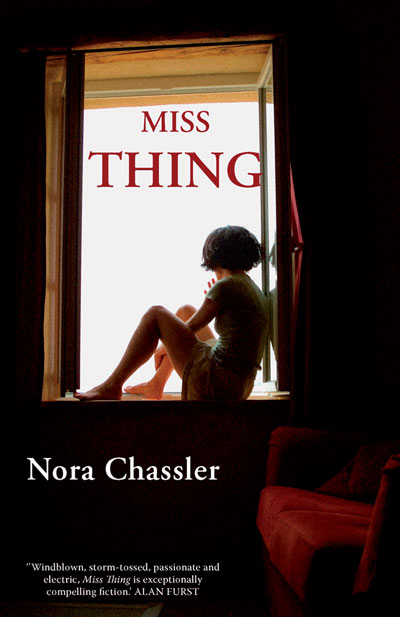
On my nightstand, Miss Thing, by Nora Chassler, Two Raven Press. The perfect summer fiction read. (P.S. Two Ravens Press is having an amazing sale on ebooks right now, with many being just £1)
Why spending more time marketing yourself on social media is not necessarily the best strategy: More Doing, Less Promoting.
Plan to attend the acclaimed true life storytelling event the Moth, in London for the first time this year at the end of August.
Sick of the Manic Pixie Dream Girl stock character, and its underlying sexist plot-line? You’re not the only one: Why the Manic Pixie Dream Girl Must Never Return. For MPDGs who fight to have a story of their own, see Andromeda, the title character in Nora Chassler’s story Miss Thing, mentioned above, and Tricia Fish’s (script writer) Moonie, title character of one of my favourite movies, The New Waterford Girl.
The internet is down, as it so often is on a rainy day. I find it reassuring that human technology has not moved so far into the beyond as to make weather irrelevant. The lack of internet leaves the morning feeling quieter, calmer than usual. It’s early still. Instead of logging on, I reach for a book, The Sound of a Wild Snail Eating.
Beginning my day reading for pleasure is something new for me. Lying in bed on a weekday morning, luxuriating in another person’s words is shear, toe-wriggling indulgence. But it seems appropriate for a book written more or less on the horizontal, from the bed of a woman suffering a chronic illness, connected to life by the thin but strong silvery thread of snail slime. Besides, one of the biggest learnings I’ve been gaining from this book has to do with slowing down and smelling the snails.
I’ve been reading Sound of a Wild Snail in bits and pieces over the past month in preparation for tomorrow’s book club meeting. Much as Deakin’s description of moth-watching inspired my friend to re-evaluate her position on those winged critters (Wildwood), Bailey’s story has been softening my attitude to the snails that inhabit my garden, helping me forgive them their feeding forays into my strawberries and kale.
It’s a small story with big implications. Most of Bailey’s ecological memoir takes place in the bedroom she has been confined to by a mysterious and debilitating illness and and concerns a snail in a terrarium, the only piece of nature she has access to. That a healing relationship can come so unexpectedly from someone so small and so far from human physiology is cause for optimism.
Arguments are sometimes made that there are dangerous limitations to human abilities to empathise and care. That we are built to be overly concerned with so-called charismatic megafauna — Greenpeace and its polar bears, WWF and its pandas — to the neglect of creatures that are ecologically important but far removed from us in size, biology or habitat. The Sound of a Wild Snail Eating challenges this pessimistic view of our imaginative capabilities. While it takes an extreme event of unenviable illness, Bailey proves that humans can relate to and come to care for mollusca, which are several billion years divergent from homo sapiens. Through her skilled storytelling, her contagious curiosity and her playful word-crafting Bailey takes the reader’s imagination by the hand and leads it into her world, where it can be expanded so that readers too can learn to relate to creatures that are very different to themselves.
Even viruses and pathogens are treated with interest and equanimity by Bailey, despite the part they probably played in her condition. Others in her situation might have shut themselves up in a hermetically sealed world of human artifacts, storying germs as militant invaders. She does not, turning her pen to document the important role viruses play in evolving our beautiful world.
The Sound of a Wild Snail is also a meditation on the human condition as observed from someone whose life has been reduced to the pace of a snail. Although Bailey never does so, there are clear connections here with the Slow movement, which not surprisingly uses the snail as its mascot. Bailey is able to enter into the world of the snail by slowing down and leaving behind the everday distractions that well people get caught up in:
“My illness brought me such an abundance of time that time was nearly all I had.”
While I would not wish Bailey’s illness on myself or anyone else, when viewed from the perspective of a bed or a terrarium, contemporary lifestyles of chronic busyness are not so enviable either. We all need opportunities to slow down and reconnect with ourselves and the world around us. Slowing down and staying still can bring gifts of insight. I won’t give away any spoilers, but Bailey’s long-term, everyday relationship with a snail enables her to encounter something of their lives that no scientist that studies snails has ever observed.
When so much wonder, mystery and companionship can be found in such a small and mundane piece of the world, there is cause for hope and celebration.
P.S. The photo (taken by Ronan) is of a 2009 Edinburgh Fringe Festival installation for “Power Plant” at the Royal Botanic Garden Edinburgh. I was lucky enough to see “Camera Vermicular”, by Jony Easterby, which featured live video footage of a bowl of snails put through a kaleidoscopic filter. It was mesmerising.
On the morning of July 4th, a group of 19 storytellers met at St Donat’s castle to share their work and research into using oral storytelling for healing people and communities. This colloquium was the first half of “The Well at the World’s End”, a full-day event on storytelling, health and wellbeing organised by Steve Killick and myself in the lead up to the Beyond the Border Festival in Wales.
Steve and I met a couple of years ago at the Scottish International Storytelling Festival. We discovered a shared interest in storytelling for healing and in documenting story’s powers. Our first plan was to co-author a review of the academic literature on oral storytelling and well-being. If any of you have ever done a search on Google scholar using the keyword “storytelling”, you’ll know that it’s used for everything from video games to marketing studies, but most usually for studies of books, reading and literacy. The one thing that’s really hard to find is an article on traditional oral storytelling.
So plan B. In the true spirit of storytelling, we decided to get people together, face-to-face, and ask them about their use of storytelling for health and wellbeing. And so the research colloquium was conceived. After sending virtual flyers out on all our networks, more than 40 people expressed an interest in it. On the day, we had social workers, psychiatric nurses, speech and language therapists, psychologists, educators, academics, activists and arts workers, including full-time storytellers. This diverse group shared stories of their work in schools, homes, community centres, hospitals, universities, refugee camps, nursing homes and even police stations.
While these 19 storytellers worked in a range of contexts with a diversity of people, a thread of similarity ran around the circle, a thread of connection. Storytelling connects people, it connects nurses and therapists to their patients, it connects lawyers to the asylum seekers they represent, it connects foster carers to the children they care for, it connects and reconnects communities torn apart from natural disasters, wars and terrorism, it connects people to the places where they live and to the more-than-human organisms that live among.
The neoliberal world we live in today is one of disconnection. Many of the mental health issues that plague our societies are rooted in our experience of separation from each other, from the places where we live and from the earth communities we were born into. Stories heal through connecting us to meaning, when told in the traditional manner they also provide us with a direct, visceral experience of community.
The other theme that emerged that morning was a desire to spread the word about the utility of storytelling. Everyone sitting in that circle had first-hand experiences of the healing power of story. But in a disconnected, hyper-mediated world, we have to assume that most people have never even been told a story. If we want to get storytelling into more schools, universities, hospitals and communities, then we have to collect, compile and disseminate evidence of its effectiveness. Research, both inside and outside the academy, has a part to play in this. The colloquium is a step towards documenting the contribution storytelling can bring to healing our world.


 Restorying the Earth