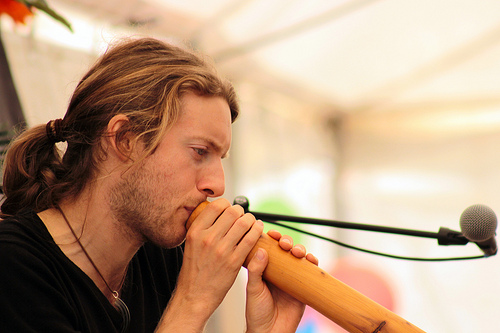
ME You recently went on a walk across Scotland telling stories along the way, what that was like and what did you learn from your journey?
DANIEL It was hard. Very hard. I was on a tight schedule which on some days required over twenty miles walking with hardly a break. It rained torrentially during the first week and I developed enormous blisters. The paths were boggy and sometimes submerged.
The second half was far easier – the sun shone, my gear dried out and I had only one one very long day, over the Lammermuirs on the final stretch home. The performances went well, without exception. The children loved learning that I had just come down from spending a night in the woods or on the hills and when I told them I had a story about a ghost who lived up in those hills they took what i said very seriously! I was aiming to re-story the earth for them, fill the lands around them and their imaginations with wonders, and I apparently succeeded. What the long term effects will be, I can only hope.
But when I say it was hard I’m not talking about blisters or about putting up a sodden tent in the rain. It was hard because I had to face up to the state of Scotland. I walked two hundred miles coast to coast across the country, on an official and well-run walking trail, and saw only one significant area of land that could be called natural. The rest of what I saw was what is sometimes referred to as the ‘wet desert’ – barren hillsides where nothing grows beneath the hooves of sheep. Conifer plantations made up the rest.
The most depressing day was the second-to-last, when I crossed the Lammermuirs, the stretch of hills between East Lothian and the Borders which I grew up on the edge of. Here I encountered another desert – a vast wasteland managed to maximise the production of small birds so that rich people can shoot them.
What really got under my skin was the sign at the edge of the moor. It described the moor as a rare habitat, and said that as it was such a rare and special habitat ‘it is important that we manage it carefully’. Moors like this are rare because they are a man-made habitat, made for profit at the expense of the wildlife that belongs there. The sign then went on to encourage me to look out for merlins, golden eagles and hen harriers that lived there. Funnily enough I didn’t see any, as all such birds are routinely shot and poisoned by game keepers. I didn’t see anything save for grouse and heather. The place felt like a concentration camp.
That our land is manipulated and abused in this way, and then sold to us as rare natural habitats which must be managed by the good-hearted estate owners who know so much better than the rest of us, made me very angry. It spurred me on to do a lot of reading and research as to how things ended up this way and what can be done about it. I believe that a combination of rewilding – bringing back apex predators, replanting native trees then allowing ecosystems to run themselves – is one of the answers, combined with big changes in land ownership and a move from a rural economy based on subsidised meat farming and bloodsports tourism to one based on ecotourism. It’s also made me fiercely pro-independence, as I believe we have a better chance of achieving all this with a government closer to us and elected by us.
ME What do stories and storytelling contribute to environmental education/social change/connecting people to nature/to the land (pick as many or as few as you’d like to address)?
DANIEL For children to grow up caring about nature they need to have, and deserve to have, awe-inspiring encounters with it. When the majority of us lived in rural locations and before the wolves and bears had been shot, these wouldn’t have been difficult to arrange. Nowadays we have an urban youth who see nature as something ‘other’ that they are not part of.
We tend to think the answer to this is to round up some animals – decimating wild populations in the process – and stick them in zoos and theme parks. Children can and will fall in love with the animals they see in these places, but all the time they are being fed a message – it is okay to imprison and harm animals for our entertainment.
Advocates of zoos and marine parks will say that such places make children grow up caring for these animals and their environments. I see storytelling as alternative to this. I recently toured Edinburgh schools telling stories about Scotland’s ‘Big 5’ animals – the red deer, red squirrel, golden eagle, harbour seal and otter. Simply through listening to stories the pupils entered into the worlds of these animals, leaving the sessions exhilarated and full of new-found appreciation of and respect for them. We don’t need to have caged animals paraded in front of us to connect us to nature – we need our imaginations and the stories that our ancestors have left for us.
ME Where do you find the stories you tell? (If you have any web-links that would be great)?
DANIEL Though I tell a good few stories that i have learned from our tellers and people I have met on my travels, the majority have come from books. I think this is because it is such a rare thing to find a story that is just right for you – the ratio is probably less than one in a hundred. This necessitates buying and searching through a lot of books! But there’s nothing like the satisfaction you get when you find one and just know that it will be with you for the rest of your life.
I tell a lot of Siberian stories – I love the animistic worldview they portray and that they have managed to retain the purity of this worldview where so many other cultures have succumbed to the homogenising effects of the western story-model. I am hugely indebted to the work of Kira Van Deusen, a Canadian storyteller and researcher who has done an incredible amount of work in gathering the stories of the tribes and who has been very generous in hearing her knowledge and work with me.
ME What is your favourite story for telling in relation to environmental education and why?
DANIEL Tough one… it might change tomorrow, but today I’ll say ‘The Maiden of the Deep Forest’, a story I learned from Martin Shaw. In it, a young prince is sent out on a quest to the far reaches of the kingdom to bring back something that shows he is fit to be king. When he finds and accepts something both hideous and beautiful, life-taking and life-giving, then he is ready to become king. I love the story as it contains such a wealth of knowledge and transmits it through one of the most gruesome scenes I’ve ever encountered in a story! Which, of course, never fails to engage teenagers.
I’d always seen it as a metaphor for the creative process – reaching down into the depths of the psyche to find the hidden jewels – and for the initiation process, where one becomes whole by uncovering and learning to love one’s inner darkness and demons. However, I have recently come to see it as reflecting the need we have for kingdoms here in the physical world that have wild, untamed, shadowy places where meeting creatures of the night is a distinct possibility.
Through such encounters we are renewed and our souls set on fire. When we come back to the centre of the kingdom, eyes wide with wonder and speaking wild tales of what we have seen, the kingdom is renewed. This is the kind of country I want children to grow up in and the kind of wild love of nature and its mysteries, danger and beauty that should come out of environmental education. It is not going to happen so long as the countryside is a barren playground where millionaires hurt animals for fun.
Storytelling populates and enriches the wild places of the psyche. Environmental education must recognise that our wild places ‘out there’ are as desperately impoverished as our housing estates before it can seek to do the same.
Links
Read more about Daniel’s storywalk on his blog: Among the Wild Deer


 Restorying the Earth